Monday, March 21, 2011

Jane's Walk in Mesa

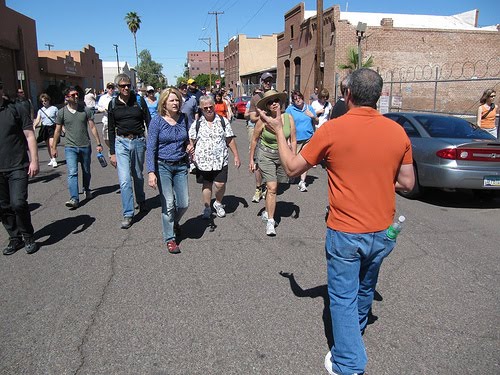
This year, West Mesa will have it's very own Jane's Walk event, organized and hosted by David Crummey.
From David:

What is Jane’s Walk? Jane’s walk honors the legacy and ideas of urban activist/writer Jane Jacobs by hosting free “walking conversations” in our community — specifically Mesa’s Downtown. Jane’s Walk Mesa will take place at some time on May 6-8th of this year. There will be many other Jane’s Walks being hosted in the valley, state, nation and the world that weekend. (Last year there were 350 walks in 42 cities, from Mumbai to New York, Salt Lake City to Toronto!)

As mentioned above, the event will take place the first weekend in May. The route through Downtown Mesa is still being finalized, but is sure to include some little known aspects about our downtown and it's history, and some interesting people. Come join this innovative walking conversation experience, and make your voice heard. The final stop on the tour will be a destination for dining and libations.
Jane's Walk is a grass roots event, focused upon integrating the living experience's of all members of the community. Jane's Walk welcomes any and all members of our community, to share and enrich the collective
outlook.

Find Jane's Walk Mesa in facebook:
Janes Walk Mesa

You can find out more on the Jane's Walk website for Phoenix

And visit the national/International Janes Walk website.

__

Friday, March 18, 2011

Building a Brand for West Mesa: Pt II of VII

_
"The gift of fantasy has meant more to me than my talent for absorbing positive knowledge." - Albert Einstein

Branding at the Cultural Level
For West Mesa, Cultural Branding leverages unique strategies to invite distinctly value-driven individuals into our community. It seeks to share a compelling vision of a developing grassroots community that is diverse and vibrant.
It works in two core ways:
a). Strategic relationships with independent social organizations, online communities, and existing subcultures of idealists, pioneers, and individualists.
b). Targeted marketing messages, using a unique voice and compelling metaphors and imagery, connecting West Mesa with specific shared cultural values.

West Mesa has unique challenges and requires unique solutions. More than just advertising to suburban shoppers, we need to reach people- inviting them to live, work, and invest. Unlike traditional top down development efforts, branding at the cultural level works at the grass roots to stimulate revitalization and investment from the bottom up.

The Message
West Mesa has developed alongside of neighboring communities in unique ways, and offers special intrinsic qualities and undiscovered possibilities. Marketing messages for West Mesa should compel people to recognize the Value within our community, by stimulating them to:
Understand it's unique qualities
Explore it's potentials- both existing and virtual
Share in our aspirational vision

Success for West Mesa will not come from whitewashing it's history, or from giving it a suburban make-over. We do not need to become more like Scottsdale, nor will we be saved by corporate retail. West Mesa will see it's potential in positioning its self as an intuitive destination for modern pioneers and value-driven individualists.

West Mesa : From Opportunism to Idealism
West Mesa needs individuals who are sold upon our community's unique potential and are willing to share in the revitalization cause- directly or indirectly.

A Cultural Brand development process seeks to shift the investment climate in West Mesa from one of opportunism to one of idealism. It stimulates an awareness of the intrinsic values of West Mesa, and invites key individuals to invest within our community and it's assets, not to exploit them.
Instead of laws, ordinances, and zoning, Cultural Branding elicits people's best intentions by appealing to their core values.

West Mesa: Our Brand Now
Public perception is neither fair nor objective.
No other community in the east Valley faces the same marketing complications that our community does. Working positively against a prevailing emotive consensus in the East Valley is a core challenge for West Mesa.[1] Branding, marketing, and design speak to people at this level- and work to stimulate an alternate narrative about what's possible in West Mesa.

[1]. Tempe's 85281 zip code and Mesa's adjacent 85201 possess remarkably similar crime statistics. Temp's 85281 is known as a place for shopping, nightlife, and the university experience, while a few miles away in 85201 it is considered “dangerous”.

[1] Our city's image dramatically influences what journalistic tone is considered consumable by the public, and provokes educated and experienced individuals to repeat things about Mesa that are inaccurate. It's common to hear statements based within assumptions that East Tempe is "too run down to be Tempe", so it must be Mesa- And that Southwest Mesa is "too nice to be Mesa", so it must be Chandler.

Monday, March 14, 2011

Building a Brand for West Mesa: Pt I

The Case for Cultural Branding and Placemaking in our community.

"The best vision is insight." - - Malcolm Forbes

West Mesa: A Brand Strategy
West Mesa is a special place. Situated centrally within Phoenix's desirable East Valley, it has neighborhoods of universally affordable homes and bargain rate property taxes. It's history creates a cultural texture that is at once both unique and accessible. Most importantly, in a time of manufactured suburbs and ubiquitous corporate retail, West Mesa is a community where a pioneering energy can still be felt, and the average person can still make a difference.

Branding

Why do we need Branding?
West Mesa will not be revitalized by the availability of upscale shopping. It is not feasible now or any time within the foreseeable future that private developers will "bulldoze" our older neighborhoods and build a new, homogeneous suburb again. Our community is, and will continue to be made of diverse, integrated neighborhoods, centrally located within the East Valley. Our community has evolved and our identity should celebrate celebrate our unique strengths.

The Power of Branding
Nearly every Fortune 500 multinational company that competes for the public's embrace positions Brand strategy at the core of their business. Cincinnati, Ohio's Proctor & Gamble produces Twenty Four unique Brands for 80 different countries, and is credited with introducing the innovation of “Brand Management Strategy” to the business world.
For P&G, Branding is the primary consideration in all of their development efforts: the creation of intellectual property and design, marketing, and advertising. It is comprehensive, user-focused, and relies upon three key devices:

Strategy- It is created with a specific consumer in mind, with intense understandings of their habits, sensibilities, and values.
Experiential- It creates a string of harmonious, concise experiences that reinforce a compelling message and create lasting emotional imprints. It compels people to think and imagine for themselves.
Story-telling- It creates a humanized identity for a product or entity, that people can identify and empathize with, and trust.

A comprehensive Brand strategy for West Mesa should invite idealism and leverage the synergy of shared values. In this way, strategy for West mesa should rely upon the concept of Cultural Branding to invite distinctly value-driven residents, entrepreneurs, and investors into our community.

Part II of the series >>


Resources
http://www.fastcompany.com/magazine/95/design-qa.html
http://www.businessweek.com/innovate/brandequity/

Sunday, March 6, 2011

This Old Downtown (Mesa)

Regardless of how we think that Downtown Mesa needs to change or evolve, someone at thisoldhouse.com is bragging about it right now:

Best Old House Neighborhoods 2011>>


<< Mesa Historic Home Tour in Mesa's "West Second st Historic District", just north of Downtown.


This isn't an entirely new phenomenon, as the charm and potential of this area have been recognized before: See the Phoenix magazine article>>


Read the whole article on Duke Manor >>


___

Thursday, March 3, 2011

Sense and Sustainability


Driving back from Lunch today I noticed some construction at one of the token apartment buildings on N Country Club Drive. Being the consummately nosy neighbor that I am, I happened to also notice that what they're building isn't normal slumlord-type stuff- it's actually kind of sleek and shiny.


The foreman on the job was happy to talk about the work. From him I learned that the cost for the entire project is "In the Millions", and that the solar panels cost "over 500,000 dollars alone". Sounds like a ton of money to spend on aging apartment complex in West Mesa, right?


The important facts are this: at this particular rental complex, where individual meters for each rental unit were not part of the original construction and all utilities are paid by the property owners, a solar installation like this will cut the monthly utility expenses in half.
That translates directly to a savings of 150,000 dollars per year for the owners.


The solar structures now shade the residents' vehicles- converting light energy that would normally make the blacktop a summertime heatsink- and the structures have solar powered lights on the underside that light the parking areas at night.


Overall, it's a win/win/win. The improvements make the residents' lives more comfortable, generate huge monthly savings, and add to the value of the property.
And it's happening now in West Mesa.

Thursday, February 10, 2011

West Mesa:Thinking about Demographics

West Mesa has a choice- proactively foster living experiences for specific demographics, or continue to be chosen by absentee landlords and people looking for a cheap place to stay while watching the housing stock and tax base steadily decline.

Over the next ten years, Housing preferences are predicted to shift dramatically.[1] West Mesa can take advantage of this shift- away from suburban lifestyle towards centrally located living- by providing specific living experiences for Generation "Y" ( Millenials), and their parents, Baby Boomer Retirees.

Millenials
Why?
West Mesa possesses an advantageous proximity.
It's convenient enough that it is often blurred with "Tempe". Many understandably don't recognize the existing boundaries between Mesa/Tempe/Chandler. Residents of the Villagio on Rio Salado Dr live in a trendy upscale development that also happens to be extremely convenient ( adjacent to Loop 101 and .5 miles from Tempe Marketplace). Do they understand that they live literally across the street from the city of Mesa?

The Mesa/Tempe border will continue to be a fascinating indicator as development continues East along the Light Rail Line into Mesa. Already, there is a Housing complex, Apache Trails ASL, under construction directly on the Tempe/Mesa border, at 2430 E Apache Blvd. The sight was selected because of "easy drive access to highways /easy walk access to Light Rail line". Another 100 feet east, and the development has arrived in Mesa.

Twelve city blocks West, development for Generation Y is thriving, and it's essentially the same neighborhood. The success of the Grigio Metro ( at right) isn't dependent upon immediate proximity to shops and restaurants -an Auto Parts store and a Check cashing outlet are the closest retail. Rather, it is built upon proximity to Light Rail.

Most Millenials don't have school aged children
This is important, as school systems continue to be a major reason that young families choose the isolation of suburbia.

Many Millenials are educated
While a college education doesn't make one a better person, it can definitely help with one's quality of life . Better income means better stability, means better neighborhoods. Millenials also possess a desire to live in "Urban" areas, and see value within becoming "Urban Pioneers"- that is, becoming part of a community and making things better. Our wisest move is to befriend and empower them as a whole, and allow them to share the revitalization burden with us.


Baby Boomer retirees.
Why?
Again, proximity is key. West Mesa is close to the airport and major freeways, yet much of it is exempt from the hustle & bustle of rush hour and retail shopping. We're still a bedroom community, with many interior neighborhoods that remain astonishingly quiet and gentile.

Why Baby Boomers?
The unfortunate facts are that seniors have collectively lost almost half of their retirement wealth.[2] Meanwhile there is an abundance of essential budget shopping here in Mesa. Post housing collapse, the plain facts are that retirees will increasingly be shopping at WalMart, and not Nordstroms. Discount stores, basic grocers, and thrift stores in close proximity will prove to be valuable resources for them.

Seniors make good neighbors
One of the factors that significantly decreases quality of life in an urban environment is noise. Seniors predictably and endearingly possess a gentler and more quiet approach to daily life.

Seniors are gentle on infrastructure
Mesa has serious budget problems that affect everything- including streets and infrastructure. We, as a community, need a break.
Seniors are exempt from the rigors of daily commuting. They often take public transportation, walk, or use motorized wheelchairs instead of driving. That means less pollution- both noise pollution and air pollution- and less wear and tear on our roads. Over time, this has a huge effect on a neighborhood.

Seniors are stable
One of the most harmful things to the business model of any rental community is "turnover". Instability kills profitability and makes it less likely that owners of rental communities have the funds to re-invest or maintain those properties.

Seniors of all income levels are more likely to be supported by Social security, social programs, individual retirement plans, and families. Some of the most stable communities in Mesa's older neighborhoods are for Senior living.

What about everyone Else?
It's accepted that there will continue to be a considerable portion of the population that will desire to live in the suburbs-isolated from public transportation and housing density /diversity, but there will be an increasingly large sector of the population that will want and need to live in a more urban scenario.

Making a place for them is an investment in our future. Planning, Design, and Marketing are key.

[1] http://www.washingtonmonthly.com/features/2010/1011.doherty-leinberger.html

[2] http://www.usatoday.com/money/economy/housing/2009-06-04-foreclose-mortgage-seniors_N.htm#chart

Grigio Metro:
http://www.grigiometro.com

Apache Trails ASL:
http://www.apacheasltrails.com/main.html

Friday, January 28, 2011

Why Design Matters

I often complain that here in Good Ol' Mesa, design is still seen as something "extra". The idea that things have to look a specific way is just a little too superficial for some folks here.

But the saying goes "If you choose not to decide, you still have made a choice". This is especially true when speaking about Design. Design, as I find my self asserting over and over, is Communication.

"Design is Communication"

Municipalities and Corporations pay for design because it has the ability to influence perceptions and control spending behaviors. Ultimately, business invests in design because it affects the bottom line.
...and even a lack of design sends a specific message.

These two building facades are good examples.


This Design (above) communicates to the people of West Mesa : " Stay Out. We don't want you- we don't trust you". More importantly, a street made of imposing building facades like this creates a neighborhood where people aren't attracted to want to live, shop, or do business. The design seems to emphasize that "We don't feel safe or comfortable here- and neither should you", and erodes something already in short supply here- community pride.

Both of these structures are located on N Country Club Drive, no more than a block apart from one another, and represent major health care organizations in the Valley.


This Design communicates that "We are part of your Community", and that "something good can happen here". It contributes to a healthy atmosphere for our neighborhood, and is an asset to the surrounding businesses. A street full of facades like this could permanently change the dynamics of a neighborhood for obvious reasons.


Instead of being pushed out to the street with "NO" signs, the Bus Stop has been incorporated into the design without any compromise to the security or integrity of the facility.


The parking lot and second facility were recently completed, as seen from 10th Street. Along with landscaping and lighting, the complex has a cohesive and inviting feel that helps to establish a healthy tone for the neighborhood.


While the people of West Mesa are happy to have large organizations invest in our community this way, this comparison highlights the real effects that translate beyond just dollar signs.

Companies that make large capital investments here have a choice: they can exercise leadership within the business climate here, or they can exploit the location for it's convenient proximity while ignoring the effects of their decisions on us and our neighborhoods.

The first design funnels tax revenue into the municipal coffers, while leaving us as residents, neighbors, and small business owners on our own to worry about how we will attract quality neighbors, rental tenants, and clients/customers to our community.

The second design enhances our neighborhood, and makes it more likely that individuals with something to offer will want to live in and invest within our neighborhood. It also contributes to a sense of community pride.

We need more of the latter. We, as resident tax payers and homeowners have the right to a say in how zoning and design are interpreted within our neighborhood. We have the right to demand the best for our neighborhoods, and that our city leaders exercise vision when it comes to how the community will continue to develop and adjust to an overall climate of uncertainty.

Stand up for your neighborhood. Make your voice heard.